Heracles / Hercules
Greatest hero of Greek myth, god of strength
Heracles is the strongest hero in Greek mythology, famous for his Twelve Labours against impossible monsters. He began life as a mortal hero and ended it as a god on Mount Olympus.
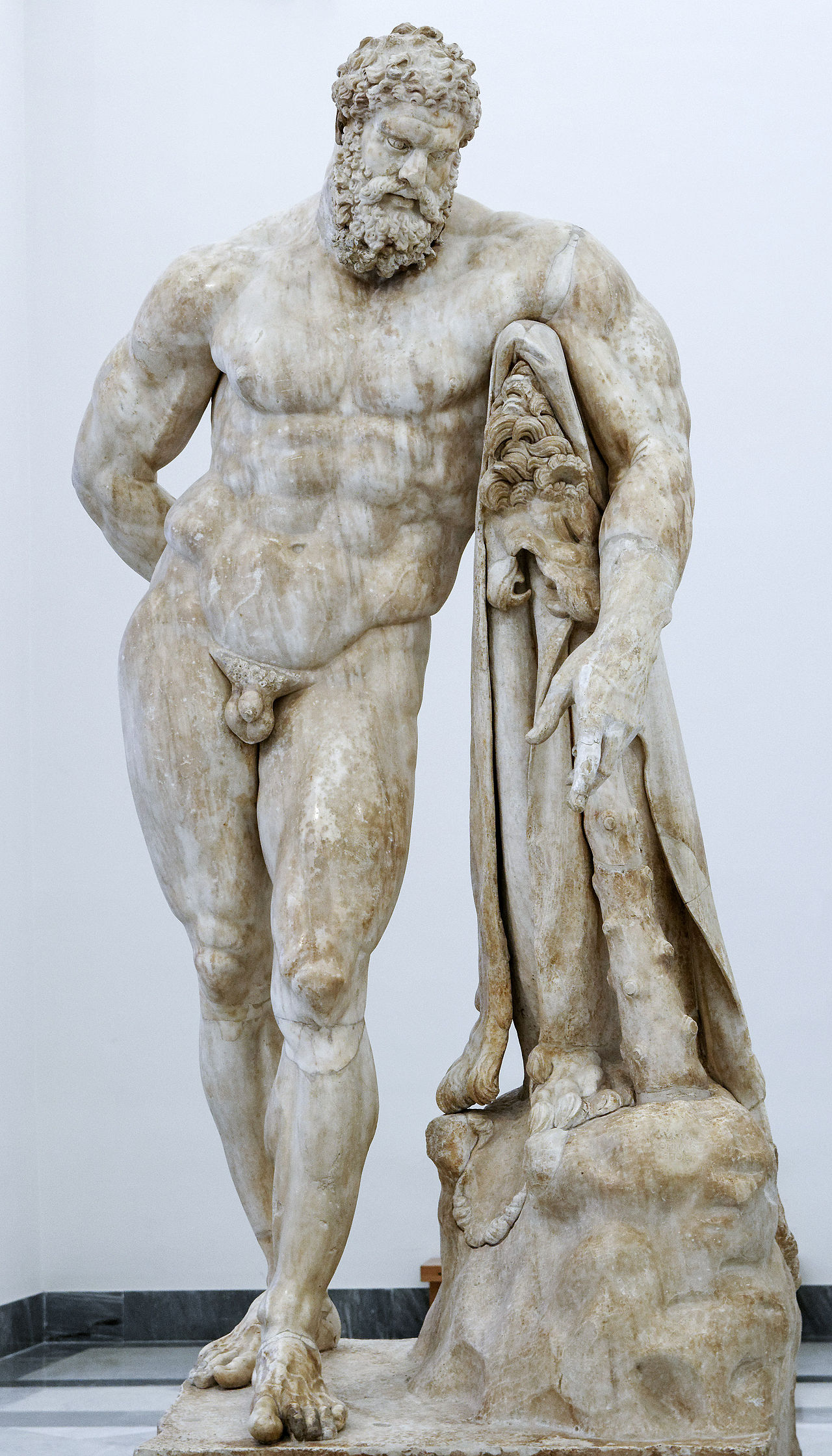
How they were born
Heracles was the son of Zeus, king of the gods, and Alcmene, a mortal queen of Thebes. Zeus disguised himself as Alcmene's husband Amphitryon to visit her, and she gave birth to twin boys: Heracles, son of Zeus, and Iphicles, son of Amphitryon. Zeus's wife Hera hated the boy from the start, and when he was still a baby in his cradle she sent two serpents to kill him. The infant Heracles simply grabbed a snake in each hand and strangled them both.
The greatest stories
The Twelve Labours
In a fit of madness sent by Hera, Heracles killed his wife Megara and their children. When the madness lifted, he went to the Oracle at Delphi to learn how to atone, and was told to serve King Eurystheus of Tiryns for ten years. Eurystheus set him twelve impossible tasks: slay the Nemean Lion, whose skin no blade could pierce; kill the many-headed Hydra of Lerna; capture the Ceryneian Hind and the Erymanthian Boar; clean the Augean Stables in a day; drive off the Stymphalian Birds; capture the Cretan Bull; steal the man-eating Mares of Diomedes; take the girdle of Hippolyta, queen of the Amazons; fetch the cattle of the giant Geryon; steal the golden apples of the Hesperides; and bring Cerberus, the three-headed hound of the Underworld, up to the world of the living. He completed them all, and the labours became the defining adventures of Greek heroism.
The Madness and the Labours
Heracles had won glory as a young man, marrying Megara, daughter of King Creon of Thebes, after helping defend the city. But Hera had never forgiven Zeus for fathering him, and she struck Heracles with a terrible madness. In his frenzy he mistook his own family for enemies and killed Megara and their sons. When he came back to his senses and saw what he had done, he was broken with grief. It was this crime, not any quest for glory, that sent him to Delphi and then to Eurystheus — the Twelve Labours were his penance, and he carried out every one of them to earn forgiveness.
Heracles Frees Prometheus
On his way to fetch the golden apples of the Hesperides, Heracles travelled to the Caucasus Mountains, where the Titan Prometheus was chained to a rock. Zeus had punished Prometheus for stealing fire and giving it to humans, and every day an eagle came to eat his liver, which grew back each night. Heracles took up his bow, shot the eagle dead, and broke Prometheus's chains, freeing him after many long years of torment. It was one of his kindest deeds, and the gods approved of it — Zeus himself had come to regret the harshness of the punishment.
The Poisoned Shirt and the Pyre
Years later Heracles married Deianira, and on a journey home they came to a river where the centaur Nessus offered to carry Deianira across. Halfway over, Nessus tried to seize her, and Heracles shot him with an arrow dipped in the Hydra's poisoned blood. As he died, Nessus told Deianira that his blood was a love charm, and that she should keep some of it. Later, fearing Heracles loved another woman, Deianira smeared the blood on a shirt and sent it to him. The poison burned into his skin and no one could pull the shirt off. In agony, Heracles built a great funeral pyre on Mount Oeta and lay down on it. As the flames rose, Zeus lifted him up to Olympus, where he became a god and married Hebe, goddess of youth.
Family & connections
Symbol, animal & weapon
Fun facts
- Heracles wore the skin of the Nemean Lion as a cloak for the rest of his life, because no blade could cut it — he had strangled the lion with his bare hands and then used the lion's own claw to skin it.
- The Pillars of Hercules, the two rocky headlands on either side of the Strait of Gibraltar, were said to have been set up by Heracles to mark the edge of the known world.
- Heracles was so strong that when he held up the sky for Atlas, Atlas tried to trick him into holding it forever — Heracles agreed only if Atlas would take it back for a moment while he adjusted his cloak, then walked away.
- The constellation Hercules in the night sky is named for him, and the hero's club and lion skin are still shown in the stars.
Gallery — sculpture & art


